Quick Answer
An Environmental Site Assessment (ESA) helps identify potential environmental concerns on a property before you purchase it. It can uncover past land uses, contamination risks, underground storage tanks, or other issues that could affect your investment. Completing an assessment before closing gives buyers valuable information, helps reduce unexpected costs, and can provide important liability protections.
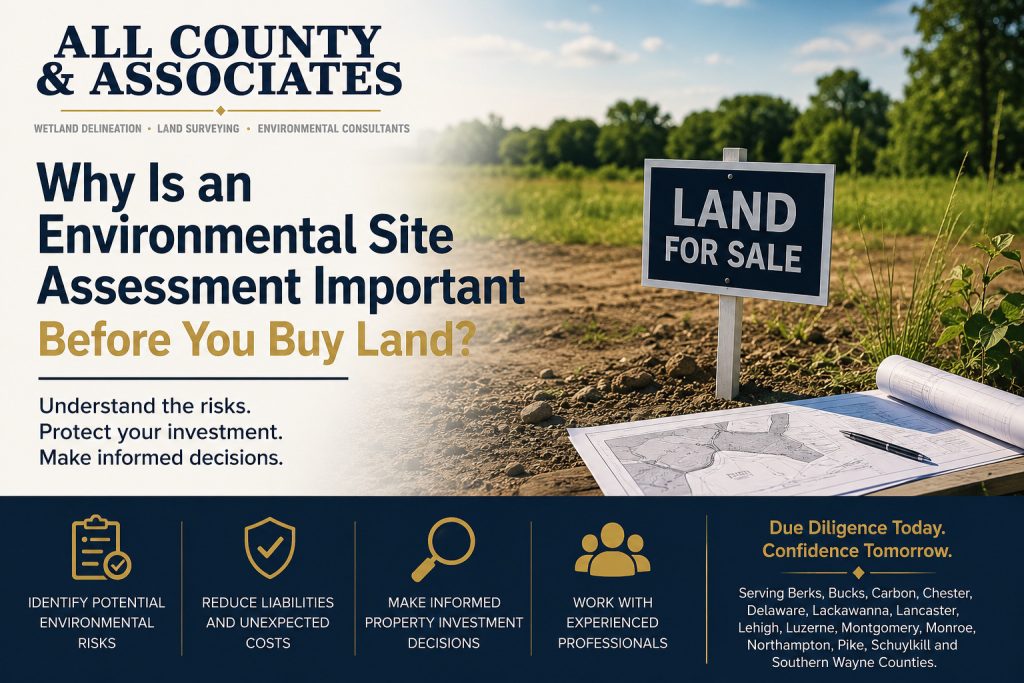
Buying land is exciting.
Whether you’re planning to build a new business, develop a residential community, expand an existing operation, or simply invest in property for the future, every parcel represents opportunity.
But what lies beneath the surface can sometimes become an expensive surprise.
Many buyers spend significant time evaluating location, zoning, access to utilities, and development potential. One step that’s occasionally overlooked is understanding the property’s environmental history.
At All County & Associates, we’ve helped clients throughout Berks, Bucks, Carbon, Chester, Delaware, Lackawanna, Lancaster, Lehigh, Luzerne, Montgomery, Monroe, Northampton, Pike, Schuylkill, Southern Wayne, and surrounding Pennsylvania communities evaluate properties before they purchase them. An Environmental Site Assessment is one of the smartest investments you can make before signing on the dotted line.
What Is an Environmental Site Assessment?
An Environmental Site Assessment, often called a Phase I ESA, is a detailed investigation into the environmental history and current condition of a property.
Rather than testing soil or groundwater immediately, a Phase I assessment looks for evidence that environmental concerns may exist.
This typically includes reviewing historical records, aerial photographs, environmental databases, previous land uses, government records, and conducting a site inspection.
The goal is to identify what environmental professionals call Recognized Environmental Conditions (RECs) that may warrant additional investigation.
Why Is It Important Before Buying Property?
Most environmental problems aren’t visible.
A property may appear perfectly clean while hiding decades of industrial activity, underground fuel storage, chemical spills, buried debris, or contaminated fill material.
Without an Environmental Site Assessment, a buyer may unknowingly inherit environmental liabilities that become both costly and time-consuming.
Learning about potential concerns before purchasing allows buyers to make informed decisions, negotiate appropriately, or determine whether additional investigation is needed.
What Types of Properties Benefit From an Environmental Site Assessment?
Many people assume Environmental Site Assessments are only necessary for factories or industrial facilities.
In reality, they are valuable for many different types of properties.
These include:
- Commercial buildings
- Industrial sites
- Vacant land
- Agricultural properties
- Multifamily developments
- Retail centers
- Office buildings
- Former gas stations
- Manufacturing properties
- Properties being financed by commercial lenders
Even vacant land may have environmental concerns related to previous uses decades earlier.
What Happens During a Phase I Environmental Site Assessment?
A Phase I ESA follows nationally recognized standards and includes several important steps.
Environmental professionals review historical land records, examine aerial imagery, evaluate regulatory databases, inspect the property, and look for evidence of current or past environmental conditions.
The final report summarizes findings and identifies whether additional investigation should be considered.
In many cases, the assessment finds no significant environmental concerns.
When concerns are identified, buyers can move forward with additional information rather than unexpected surprises.
What Happens If Environmental Concerns Are Found?
Finding a Recognized Environmental Condition doesn’t automatically mean the property shouldn’t be purchased.
Instead, it provides valuable information.
Depending on the findings, additional investigation—often called a Phase II Environmental Site Assessment—may be recommended.
This phase can include soil sampling, groundwater testing, or other environmental analyses to better understand the situation.
Having this information before closing allows buyers to make informed decisions based on facts rather than assumptions.
Can an Environmental Site Assessment Help Protect Buyers?
Yes.
One of the important benefits of completing a Phase I Environmental Site Assessment is that it may help purchasers qualify for certain federal liability protections when conducted according to current standards and completed before acquiring the property.
For many commercial buyers, developers, and lenders, this makes the assessment an essential part of the due diligence process.
Environmental Due Diligence Protects More Than Your Investment
Environmental due diligence isn’t about expecting problems.
It’s about reducing uncertainty.
Just as buyers inspect a building’s roof or foundation before purchasing, understanding environmental conditions helps protect long-term investments and supports informed decision-making.
The cost of an Environmental Site Assessment is often small compared to the potential financial impact of discovering environmental issues after the purchase has been completed.
Choose Experience Before You Buy
Every property has a history.
Understanding that history before making a significant investment helps buyers move forward with greater confidence.
At All County & Associates, we’ve assisted clients throughout Berks, Bucks, Carbon, Chester, Delaware, Lackawanna, Lancaster, Lehigh, Luzerne, Montgomery, Monroe, Northampton, Pike, Schuylkill, Southern Wayne, and surrounding Pennsylvania communities by providing professional environmental consulting services and Environmental Site Assessments that support informed property decisions.
Should you consider purchasing commercial property, vacant land, or a redevelopment site, contact All County & Associates. We’ll help you understand the property’s environmental history so you can make your investment with confidence.